
What Global Shop Solutions publishes about pricing
No dollar figure. The pricing page on globalshopsolutions.com sets out the structure and then asks for details about your business. This is what it does say.
- Licensing is by concurrent user, meaning the number of people in the system at the same moment, not everyone who has a login
- The cost is "upfront + ongoing quarterly cost"
- Software updates and support are included in the ongoing cost of each concurrent user
- Graphical interfaces for shop floor workers are offered on the same upfront plus quarterly basis, priced as their own item
- Deployment can be on premise, cloud or SaaS
- Its FAQ puts an average implementation at three to six months, with some customers live within a month on the Fast Track option
G2 and Capterra both list the product with no price and tell buyers to contact the vendor. SoftwareConnect adds one useful detail: a 10 user minimum.
The Global Shop Solutions cost estimates you will find online
These are the ones with a source we could read ourselves. They do not agree, and some do not agree with themselves.
| Source | What it estimates | Figure |
|---|---|---|
| ERP Research | Cloud use per user | 100 to 200 USD per user a month, with a listed starting price of 65 USD |
| ERP Research | Implementation | 20,000 to 250,000 USD, two to five months |
| ERP Research | Yearly support | About 18 percent of the license cost |
| ERP Research | Typical total cost of ownership | 30,000 to 150,000 USD |
| ITQlick | Year one for ten users | 80,000 to 90,000 USD, can exceed 100,000 USD with customization |
| ITQlick | A 70 employee company with 10 million USD in sales | 60,000 to 70,000 USD initial purchase, then about 15,000 USD a year |
| ITQlick | Implementation | From 20,000 USD |
| VendorBenchmark | Single facility, 20 to 50 users | 75,000 to 120,000 USD a year, plus 40,000 to 80,000 USD implementation |
| VendorBenchmark | Advanced Planning and Scheduling | An extra 25,000 to 60,000 USD a year |
| SoftwareConnect | Minimum | 10 users |
Why they disagree: Global Shop sells the same system on premise with an upfront license, or as a cloud subscription, and the estimates mix the two. A per user per month figure describes the cloud. An upfront figure plus a smaller yearly fee describes on premise. VendorBenchmark sells contract benchmarking, so its numbers lean high and describe larger buyers. ERP Research's 65 USD starting price sits below its own 100 to 200 USD range, so treat it as a floor nobody is quoted.
What actually moves a Global Shop Solutions quote
Six things decide the number. Have an answer to each before the first call.
- Peak concurrent users. Count the most people logged in at the busiest hour, by shift. Concurrent licensing is kinder to a two shift plant than named seats, because first and second shift share licenses
- Shop floor screens. Graphical interfaces for workers are a separate line with their own upfront and quarterly cost. Ask how many terminals you need and what each costs
- Deployment. On premise means an upfront license, your server and a smaller quarterly fee. Cloud or SaaS means a higher recurring fee and no hardware
- Modules. Global Shop markets more than 35 applications in One-System ERP. Ask which ones the quote includes, especially scheduling, quality and payroll links
- Implementation option. Standard against Fast Track changes both calendar and cost, and data migration from your old system is often the biggest unknown
- Contract length. VendorBenchmark reports multi year terms with renewal increases. Ask what year four costs before you sign year one
When the cost comparison has to go in front of the owners, it helps to show it rather than send the spreadsheet, and a presentation maker that turns a report into slides saves an evening of formatting.
What Global Shop Solutions costs over three years, worked through
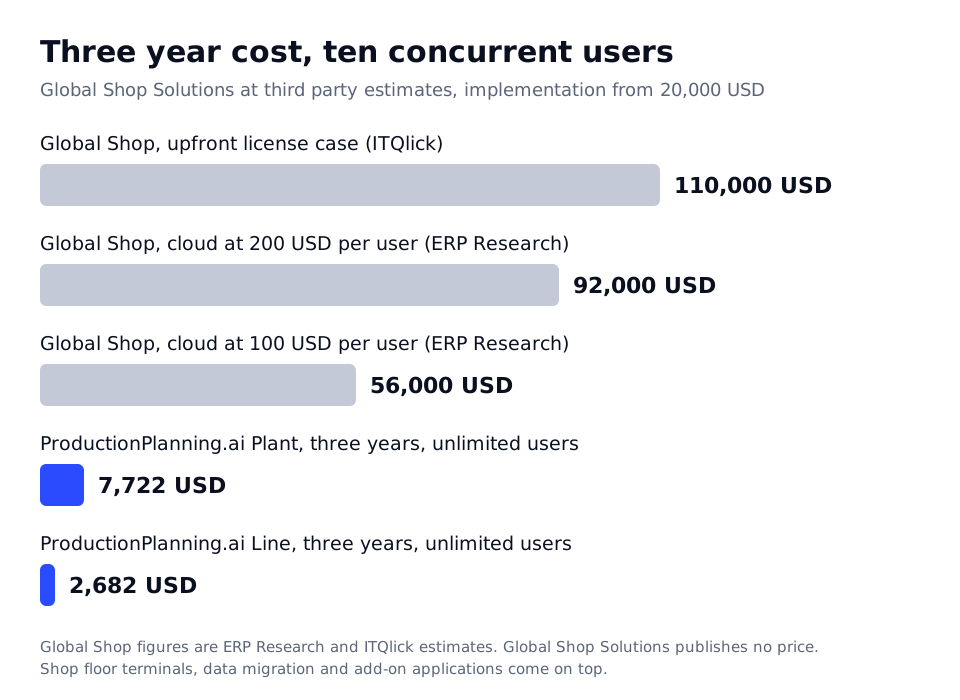
Here is the arithmetic for a plant with ten concurrent users, the minimum SoftwareConnect reports. It is a sketch from the published estimates, not a quote.
| Cost line | Low case, cloud | Middle case, cloud | High case, upfront license |
|---|---|---|---|
| Basis | 10 users at 100 USD a month, ERP Research | 10 users at 200 USD a month, ERP Research | ITQlick year one for ten users |
| Year one software | 12,000 USD | 24,000 USD | 60,000 USD |
| Implementation | 20,000 USD | 20,000 USD | 20,000 USD |
| Years two and three | 24,000 USD | 48,000 USD | 30,000 USD at about 15,000 USD a year |
| Three year total | 56,000 USD | 92,000 USD | 110,000 USD |
Implementation is held at the lowest figure both ERP Research and ITQlick give. Shop floor terminals, an APS add-on if it is quoted separately, and data migration all push the totals up, and VendorBenchmark's figures for a 20 to 50 user facility are higher than every column here.
For a 10 to 40 person plant whose real complaint is "we never know which order will ship late", that is a lot to pay for one answer. A finite capacity scheduler on our Plant plan costs 2,574 USD a year paid yearly, so 7,722 USD over three years, with no implementation fee and unlimited users. Line, for up to 10 work centers, is 894 USD a year, or 2,682 USD over three years.
Global Shop Solutions pricing model next to a per plant subscription
| What you pay for | Global Shop Solutions | ProductionPlanning.ai |
|---|---|---|
| Price visibility | Quote after a form and a call | Published on the pricing page |
| License basis | Per concurrent user, upfront plus quarterly | Per plant, unlimited users |
| Minimum | 10 users per SoftwareConnect | One plant |
| Shop floor screens | Separate upfront and quarterly line | Included on Plant |
| Implementation | 20,000 USD and up, two to six months | None, import a spreadsheet and run |
| Scheduling | Advanced Planning and Scheduling inside the ERP | The whole product |
| Accounting, quoting, quality, CRM | Built in | No, keep what you use today |
| Where it runs | On premise, cloud or SaaS | In the browser |
These are different purchases. Global Shop runs the whole business, and scheduling is one application in it. We give a smaller plant a schedule it can trust, next to the books it already keeps. Our Global Shop Solutions alternative page sets the two side by side and says plainly when Global Shop is the better buy.
What to ask on the Global Shop Solutions pricing call
Write these down first. They are the questions that change the number.
- What is the upfront cost and the quarterly fee per concurrent user, on premise and in the cloud
- Is there a minimum number of users, and what does each user above it cost
- What do shop floor interfaces cost per terminal, upfront and quarterly
- Is Advanced Planning and Scheduling in the base price, or quoted as its own application
- What does implementation cost on Standard and on Fast Track, and what does data migration from our current system add
- How long is the contract, and what is the increase at the first renewal
- Can we see Global Shop schedule our own open jobs and routings before we commit
Global Shop Solutions pricing questions buyers ask
How much does Global Shop Solutions ERP cost?
Global Shop Solutions does not publish pricing. ERP Research estimates 100 to 200 USD per user a month for cloud and 20,000 to 250,000 USD for implementation. ITQlick puts year one for ten users at 80,000 to 90,000 USD. For ten concurrent users, three years come to roughly 56,000 to 110,000 USD.
Does Global Shop Solutions charge per user?
Yes, per concurrent user, meaning the number of people logged in at the same time rather than every named person. Global Shop's pricing page describes an upfront cost plus an ongoing quarterly cost per concurrent user, with updates and support included in the quarterly part. SoftwareConnect reports a 10 user minimum.
How much does Global Shop Solutions implementation cost?
Global Shop does not publish it. ERP Research estimates 20,000 to 250,000 USD over two to five months, and ITQlick says implementation starts at 20,000 USD. Global Shop's own FAQ puts an average rollout at three to six months, with some customers live within a month on Fast Track.
Is Global Shop Solutions cheaper in the cloud or on premise?
It depends on how long you keep it. On premise means a larger upfront license and a smaller quarterly fee, plus your own server. Cloud and SaaS spread the cost into a higher recurring fee. On the published estimates, ITQlick's upfront example of 60,000 to 70,000 USD plus about 15,000 USD a year costs more than ERP Research's cloud range of 12,000 to 24,000 USD a year for ten users in every year we modeled, so ask for both quotes.
Is Global Shop Solutions worth it for a small manufacturer?
It can be for a manufacturer replacing several disconnected systems with one ERP, with a team that can own a three to six month rollout. For a plant of 10 to 30 people whose books and quoting already work, an ERP license and a project are heavy if the main problem is the schedule. Our best production scheduling software roundup compares smaller options with real prices.
What is a cheaper alternative to Global Shop Solutions?
For a whole ERP, buyers compare Global Shop with JobBOSS2, ProShop, Epicor Kinetic and Cetec ERP, which publishes per user prices. If late orders are the problem, a dedicated scheduler is the cheaper fix: ProductionPlanning.ai costs 149 USD per plant a month with unlimited users, next to the system you already run.
Price the schedule before you price the ERP
If late orders are the problem, fix them first for a flat price per plant with the whole floor included. Start on Line at 149 USD a month, or run the demo on a sample week of orders and see where your bottleneck really is. Our pricing page lists every plan, and JobBOSS pricing and ProShop ERP pricing work through the same arithmetic for the systems Global Shop buyers most often compare.